
The Hidden Risks of Local Administrator Rights in Your Business

Business Tech Made Simple by NexFixIT
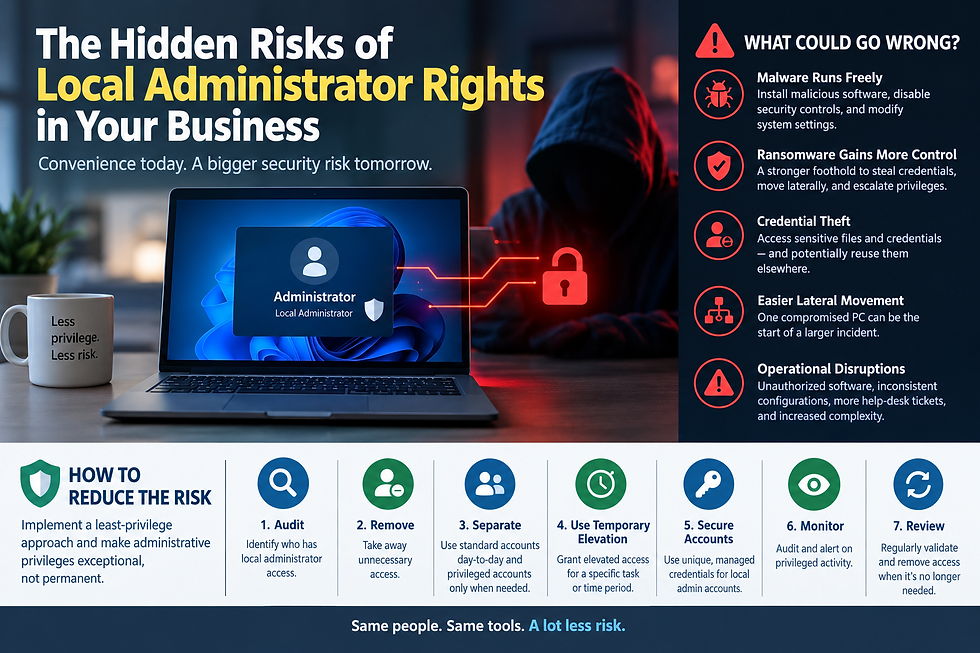
Local administrator rights are one of the most overlooked cybersecurity risks in small and mid-sized businesses. While giving employees elevated permissions may seem convenient, local administrator rights can significantly increase the risk of ransomware infections, malware attacks, accidental system changes, and compliance violations.
Giving employees local administrator rights is similar to giving every employee a master key to the building. While most people will use that access responsibly, it only takes one mistake, one phishing email, or one malicious download to create a serious problem for the entire organization. Cybercriminals know this and actively target users with
administrative privileges because those accounts can provide a direct path to sensitive systems and company data.
What Are Local Administrator Rights?
Administrator access allows a user to make significant changes to a computer. This includes:
Installing and removing software
Changing security settings
Creating user accounts
Modifying system files
Disabling antivirus or security controls
Installing device drivers
These permissions are necessary for IT administrators, but they are rarely required for day-to-day business operations such as email, web browsing, accounting, engineering, customer service, or office productivity tasks.
Why Local Administrator Rights Increase Cybersecurity Risk
Malware Gains More Power
When a user with administrator rights accidentally runs malicious software, that malware often inherits the same elevated permissions.
Instead of infecting a single user profile, the malware may be able to:
Disable security software
Modify system settings
Install persistent backdoors
Capture credentials
Spread to other systems
Many ransomware attacks become significantly more damaging because the initial victim had administrative privileges.
How Local Administrator Rights Help Ransomware Spread
Most users are not cybersecurity experts. An employee troubleshooting a software issue may disable antivirus protection, change firewall settings, or approve administrative prompts without understanding the consequences.
What seems like a harmless change to keep work moving can create a significant security gap.
Increased Risk from Phishing Attacks
Cybercriminals frequently use phishing emails to trick users into downloading files or clicking malicious links.
When a standard user falls victim to a phishing attack, the damage is often limited. When an administrator falls victim, attackers may gain control of the entire workstation and potentially use it as a launch point into the rest of the network.
Compliance and Regulatory Concerns
Many cybersecurity frameworks promote the principle of least privilege, meaning users should have only the permissions required to perform their jobs.
Organizations pursuing:
CMMC
NIST Cybersecurity Framework
Cyber insurance requirements
Industry security best practices
are often expected to limit administrative privileges and document how elevated access is controlled.
The Principle of Least Privilege as an Alternative to Local Administrator Rights
The principle of least privilege is simple:
Give users only the access they need to perform their job and nothing more.
An accountant doesn't need the ability to disable Microsoft Defender. A receptionist doesn't need permission to install software. An engineer generally doesn't need unrestricted administrative control over their workstation.
By limiting access, organizations reduce the potential impact of accidents, malware infections, and insider threats.
Common Objections
"My Employees Need to Install Software"
In many cases, they don't install software often enough to justify permanent administrative access.
Modern IT solutions allow employees to request approved software while IT reviews and deploys it quickly. This approach provides flexibility without sacrificing security.
"It's Faster to Just Make Everyone an Administrator"
It's also faster to leave the front door unlocked.
Businesses routinely trade convenience for security in areas such as physical access, accounting controls, and financial approvals. Technology should be no different.
"We've Never Had a Problem"
Most organizations that experience ransomware attacks also felt secure before the incident occurred.
The absence of a previous incident does not mean the risk does not exist. It often means the organization has simply been fortunate.
Best Practices for Managing Local Administrator Rights
Instead of granting administrator rights to everyone:
Use standard user accounts for daily work.
Maintain separate administrative accounts for IT personnel.
Require approval for software installations.
Use endpoint management tools to deploy approved applications.
Monitor and review privileged access regularly.
Train employees to recognize phishing attempts and suspicious activity.
This approach maintains productivity while dramatically improving security.
Local Administrator Rights and CMMC Compliance
Organizations pursuing CMMC certification should review local administrator rights regularly and ensure elevated privileges are limited to authorized personnel. Controlling privileged access supports the principle of least privilege and helps reduce the risk of unauthorized system changes and cybersecurity incidents.
Final Thoughts
Administrator access should be treated as a powerful business privilege, not a default setting. Every employee with elevated rights increases the organization's attack surface and creates another opportunity for cybercriminals to gain a foothold.
The safest approach is to provide employees with the minimum level of access necessary to perform their jobs. By removing unnecessary administrator privileges, businesses can significantly reduce the risk of ransomware, malware infections, accidental security changes, and compliance issues.
At NexFixIT, one of the first things we review during a security assessment is who has administrator access and whether those permissions are truly necessary. Often, reducing administrative privileges is one of the simplest and most effective steps an organization can take to improve its cybersecurity posture.
Comments